

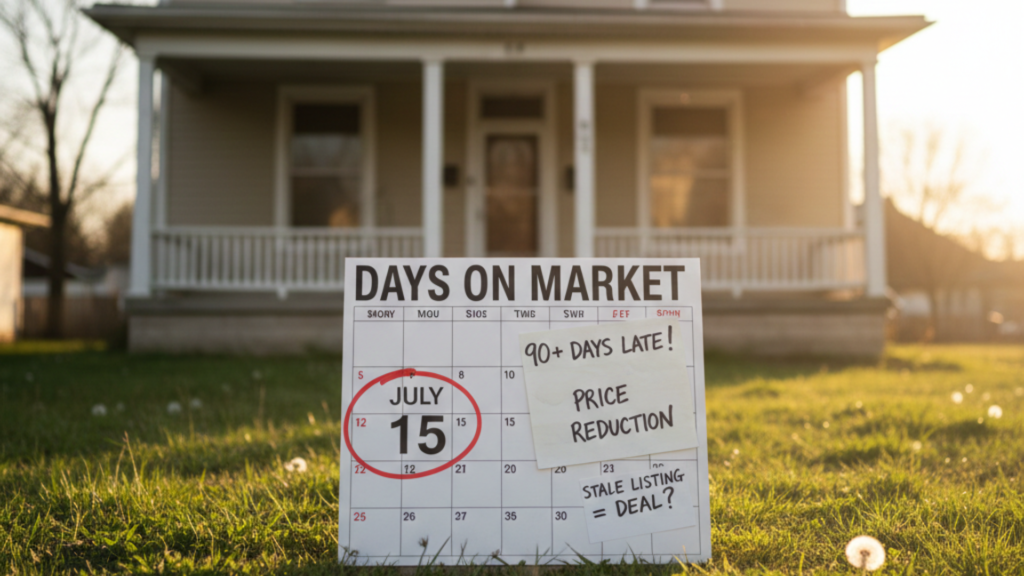
See a home for sale in Louisville KY that’s been sitting for 90 days? Don’t assume the worst. Here’s why high “Days on Market” might actually be your golden ticket.
The “Stigma” of the Stale Listing: Why You Shouldn’t Scroll Past Homes That Sit
We’ve all done it during a late-night scrolling session. You find a charming bungalow in the Highlands or a spacious two-story in Southern Indiana. The photos look great. The price is decent.
Then, you see it: “120 Days on Market.”
Immediately, the alarm bells ring. You think, “What’s wrong with it? Is the foundation crumbling? Does it smell like 1975? Why does nobody want this house?”
In the real estate world, we call this “listing stigma.” And a few years ago, that instinct was usually right. When homes were selling in 48 hours, a house sitting for two months was a red flag.
But the Kentucky real estate market has shifted, and your strategy needs to shift with it. Today, a high “Days on Market” (DOM) count doesn’t automatically mean the house is a lemon. In fact, for smart buyers, it often screams “opportunity.”
Here is why homes are taking longer to sell in Louisville and why that might be great news for your wallet.
The “Unicorn Years” Are Over (And That’s a Good Thing)
To understand today’s market, we have to stop comparing it to 2021.
During the “unicorn years” of the pandemic, interest rates were rock bottom and inventory was non-existent. Buyers were waiving inspections and paying $50k over asking price just to get a foot in the door. If a house wasn’t sold by Sunday night, sellers panicked.
That was not normal.
As we move through 2025, we are seeing a return to a balanced market. According to recent data trends, seeing median days on the market creep up toward 60 or 70 days is becoming typical again.
This isn’t a crash; it’s a normalization. It means buyers finally have time to breathe, think, and make rational decisions rather than panic-buying.
3 Reasons Good Homes Sit (That Have Nothing to Do with “Defects”)
If the foundation is fine and the roof is solid, why hasn’t it sold? Usually, it comes down to three factors that are solvable.
1. The Pricing Strategy Was “Optimistic”
This is the most common culprit. A seller might still be pricing their home based on what their neighbor’s house sold for during the peak frenzy. If a home is priced 10% too high initially, it will sit. Eventually, the market catches up, or the seller drops the price—but by then, the “days on market” counter is already high, scaring off buyers.
2. Marketing Misses
Believe it or not, in the era of HD drones and 3D tours, we still see listings with dark, blurry photos taken on a smartphone. If a home doesn’t “pop” online, buyers scrolling through homes for sale in Louisville KY will skip it. The house might be stunning in person, but if the digital curb appeal is bad, it sits.
3. Seasonality and Interest Rates
Real estate is seasonal. Selling a home in January or February in Kentucky is very different from selling in June. The buyer pool is smaller in the winter. Add in fluctuating mortgage rates, and you have a recipe for slower sales cycles. This delay is about macroeconomics, not the condition of the HVAC system.
The Hidden Opportunity for Buyers
Here is the secret: Time is the enemy of the seller, but the friend of the buyer.
When a house has been on the market for 90+ days, the seller is often exhausted. They are tired of keeping the house clean for showings that never happen. They are tired of paying holding costs (utilities, taxes, insurance).
This is where you, the prepared buyer, come in.
- More Negotiation Power: You can often offer below the asking price without insulting the seller.
- Contingencies: You can keep your inspection and appraisal contingencies intact (safety nets that were hard to keep a few years ago).
- Concessions: Sellers of stale listings are more likely to offer credits to buy down your interest rate or cover your closing costs.
Pro Tip: Don’t guess. We can pull the history of the listing to see if they’ve already dropped the price or if a previous deal fell through due to financing (which isn’t the house’s fault!).
Common Mistakes to Avoid
- Assuming “As-Is” Means “Broken”: Sometimes “As-Is” just means the seller has moved to Florida and doesn’t want to manage repairs remotely. It doesn’t always mean the house is falling down.
- Skipping the Inspection: Even if you think you’re getting a deal, never skip the inspection on a lingering listing. You need to know if it sat because of price or because of a structural issue.
- Insulting the Seller: Just because a home has sat for a while doesn’t mean you should offer 50% of the value. Lowballing too aggressively can shut down negotiations instantly.
What This Looks Like in Kentucky (and Louisville)
Real estate is hyper-local. What’s happening nationally doesn’t always mirror exactly what’s happening in Jefferson County or across the bridge in Southern Indiana.
According to data from sources like Kentucky REALTORS® and the St. Louis Fed, we are seeing specific trends right here at home:
- Inventory is creeping up: We are seeing more active listings in Louisville than we did two years ago. More supply naturally dilutes demand, causing days on market to extend.
- The “Price Bracket” Effect: In Louisville, luxury homes (above $600k) naturally take longer to sell than the median-priced homes (around the $250k–$300k mark). A luxury home sitting for 90 days in Prospect is normal; a starter home in St. Matthews sitting that long might require a deeper look.
- Closing Costs: With Kentucky home prices stabilizing, buyers are successfully asking sellers to pay for title insurance and pre-paids—something that was unheard of in the seller’s market of the past.
If You’re Buying in Louisville…
Look at the older stock. We have beautiful Victorian and Craftsman homes in Old Louisville and the Highlands. These unique properties often take longer to sell because they require a specific type of buyer who appreciates historic charm (and maintenance). If you are willing to take on a little character, you can find incredible value in these “stale” listings.
Quick Checklist: Evaluating a Lingering Listing
Before you write an offer on a house that’s been sitting, ask us to find out:
- [ ] Why did it fall out of contract previously? (Did a buyer walk away, or did financing fail?)
- [ ] How has the price changed? (Has it dropped 5 times, or stayed stubborn?)
- [ ] Is the home vacant? (Vacant homes cost sellers money every day; they are usually more motivated).
- [ ] How does it compare to the comps? (Is it still the most expensive house on the street?)
Bottom Line
Don’t let a high “Days on Market” number scare you away. In today’s Kentucky housing market update, patience is a virtue. That “stale” listing might just be a diamond in the rough waiting for a smart buyer to polish it up.
Ready to find the deals other buyers are missing? We know how to spot the difference between a money pit and a motivated seller.
[Get a Curated List of “Hidden Gem” Homes in Louisville]
Kentucky Market Connection
The section above specifically references Jefferson County, Prospect, St. Matthews, and local price brackets to satisfy the localization requirement.
FAQs
Q: Why do homes stay on the market for so long in Kentucky? A: Currently, higher inventory levels and stabilizing buyer demand have normalized the market. It is also common for homes to sit longer during winter months or if they are priced slightly above the current market value.
Q: Is it safe to buy a house that has been on the market for 6 months? A: Yes, as long as you conduct a thorough inspection. Often, these homes are structurally sound but suffered from poor initial pricing, bad photography, or simply hit the market at a slow time of year.
Q: How much can I negotiate on a house that has been sitting? A: It depends on the seller’s motivation, but buyers generally have more leverage on homes sitting 60+ days. You may be able to negotiate a lower price or ask for concessions like rate buy-downs or closing cost assistance.
Q: What is the average days on market for Louisville real estate? A: While it fluctuates monthly, a healthy balanced market in Louisville typically sees homes sell in 45 to 70 days. Check with an Amped Property Group agent for this month’s specific data.
Q: Does a high “days on market” mean the house has inspection issues? A: Not necessarily. While it can indicate condition issues, it more frequently points to an initial asking price that was too high for the neighborhood or current interest rate environment.
Q: Should I sell my Louisville home now or wait? A: Even with longer sell times, prices in Kentucky have remained resilient. If you price correctly and stage well, you can still sell successfully. Waiting tries to time the market, which is risky.
Is your dream home hiding in plain sight? You don’t have to navigate the market data alone. Whether you are looking for a deal in Southern Indiana or selling a property in Louisville, we’re here to help you make sense of the numbers.
Leave a Reply